A Place of Our Own challenges the assumption that queerness and domesticity are mutually exclusive,
asking what it means to raise a family with both radical visibility + Southern tradition.
What is A Place of Our Own?
A Place of Our Own is a photo series about queer families in the South. It documents the ways we live, love, and build home—through portraiture, storytelling, and the everyday. Each shoot takes place inside the family’s space, with a focus on rituals, aesthetics, care, and chaos. It’s about domestic life without the filter of normativity.
Why?
Because queerness and domesticity aren’t opposites. Because the South is full of queer people making life work in ways that aren’t always visible. Because home can be a site of both safety and protest. This project exists to archive, celebrate, and complicate what it means to be radically queer and deeply rooted.
THREE BITCHES & A BABY Aalliyah, Leah, Booda, and Nahla Summerville, SC | April 2026
What does family look like? How do people create intimacy inside systems built for sameness?
On the way in, I begin to notice repetition.
New builds, new apartments, new strip malls. Grocery stores facing each other across oversized parking lots. Rows of homes that feel placed rather than grown. It’s clean, modern, and clearly intentional, but not yet fully inhabited.
This area is part of Nexton, a large master-planned community about 25 miles outside Charleston, near Summerville. Built in phases, it brings housing, schools, workplaces, and everyday life together, creating a complete community from the ground up.
It sits on land that was previously undeveloped, part of a larger push to expand outward from Charleston as the region grows. Instead of forming gradually, everything here is being constructed at once, guided by a central plan.
You can feel that planning immediately–wide sidewalks, rows of developing homes, and commercial real estate.
It carries a version of Carolina charm, but for now, it’s thin, layered over something more engineered. Like a place that knows what it’s supposed to be, but hasn’t fully become it yet.
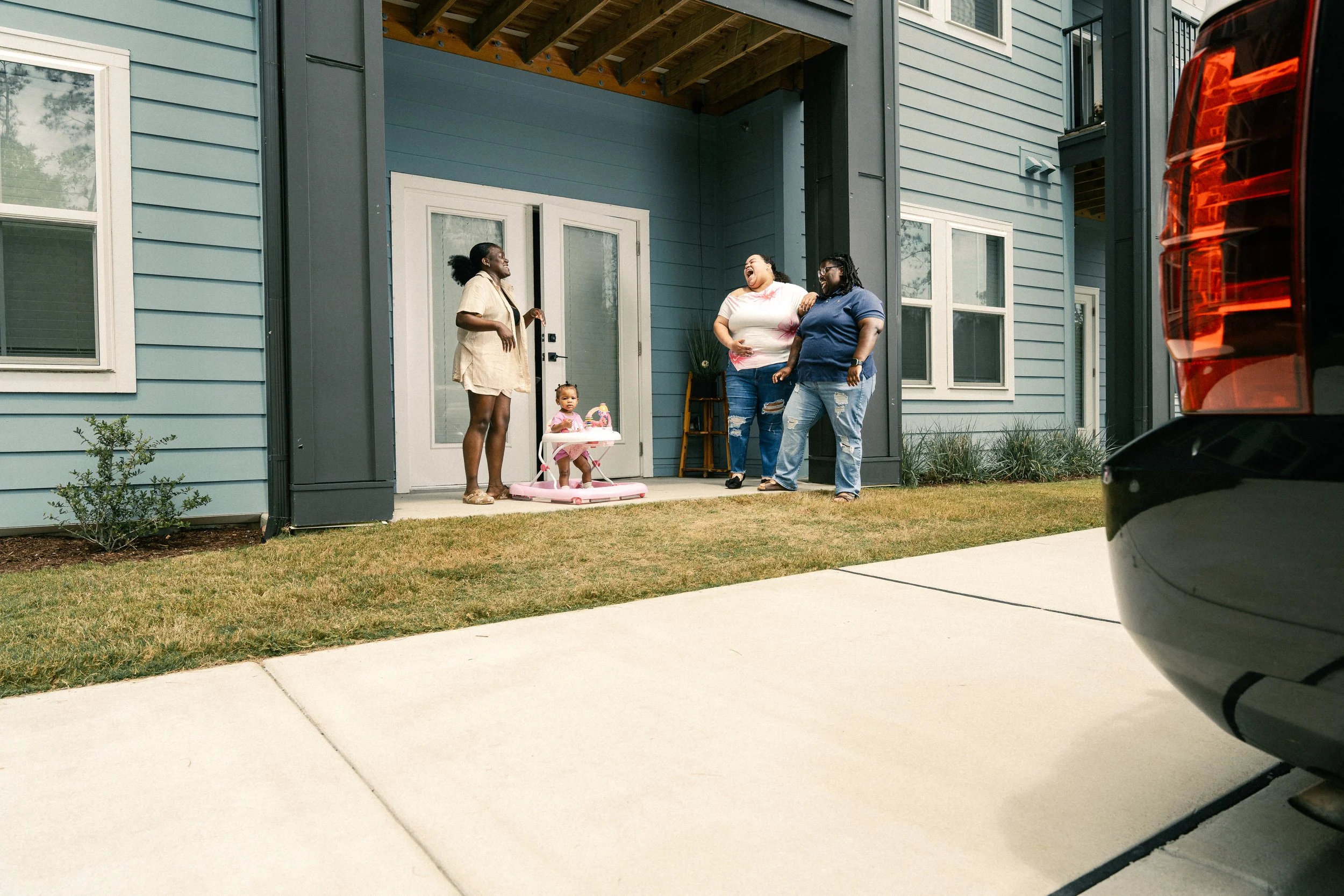
It’s all still in progress. As I approach the home, a similar sense of intention begins to carry inside.
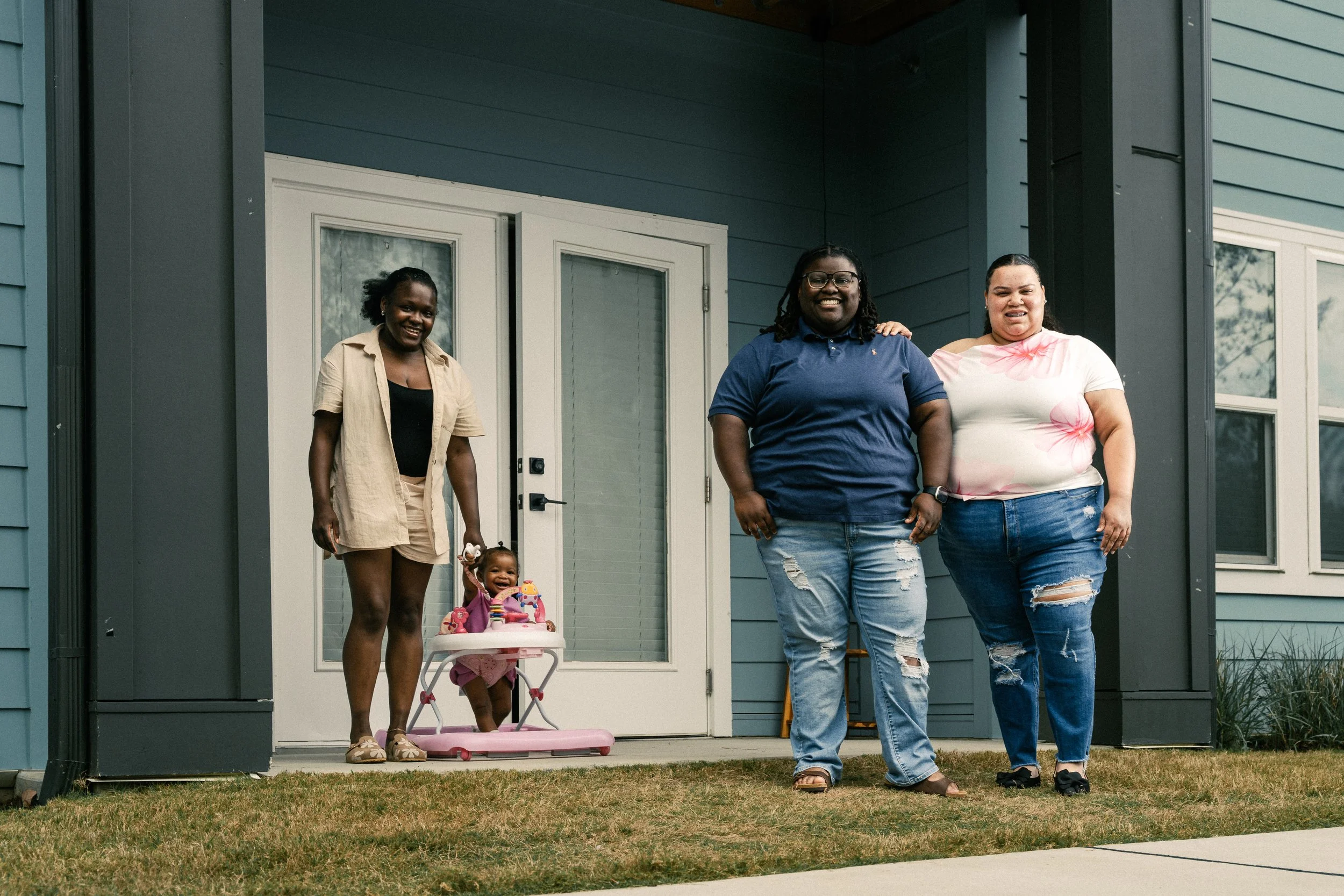
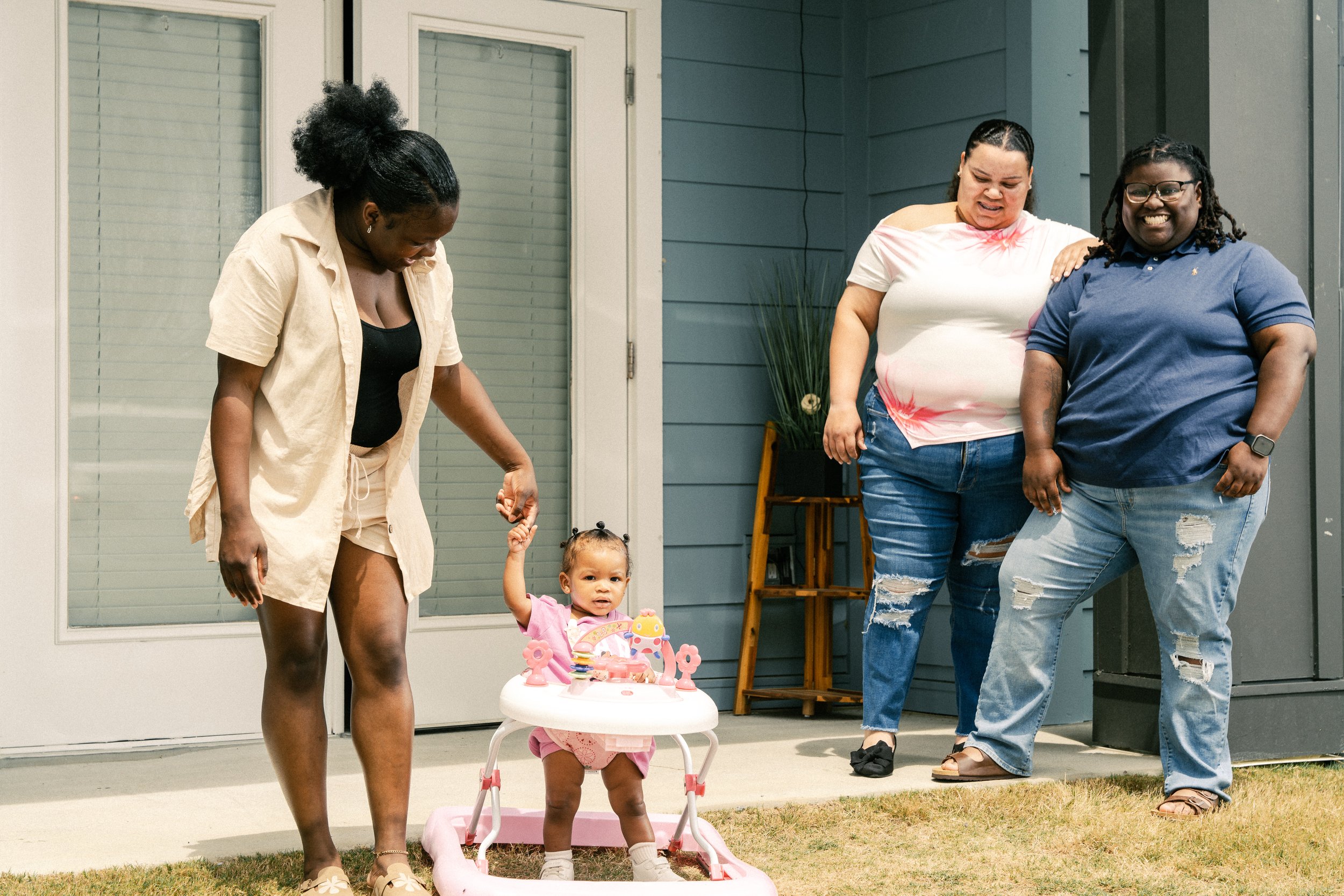
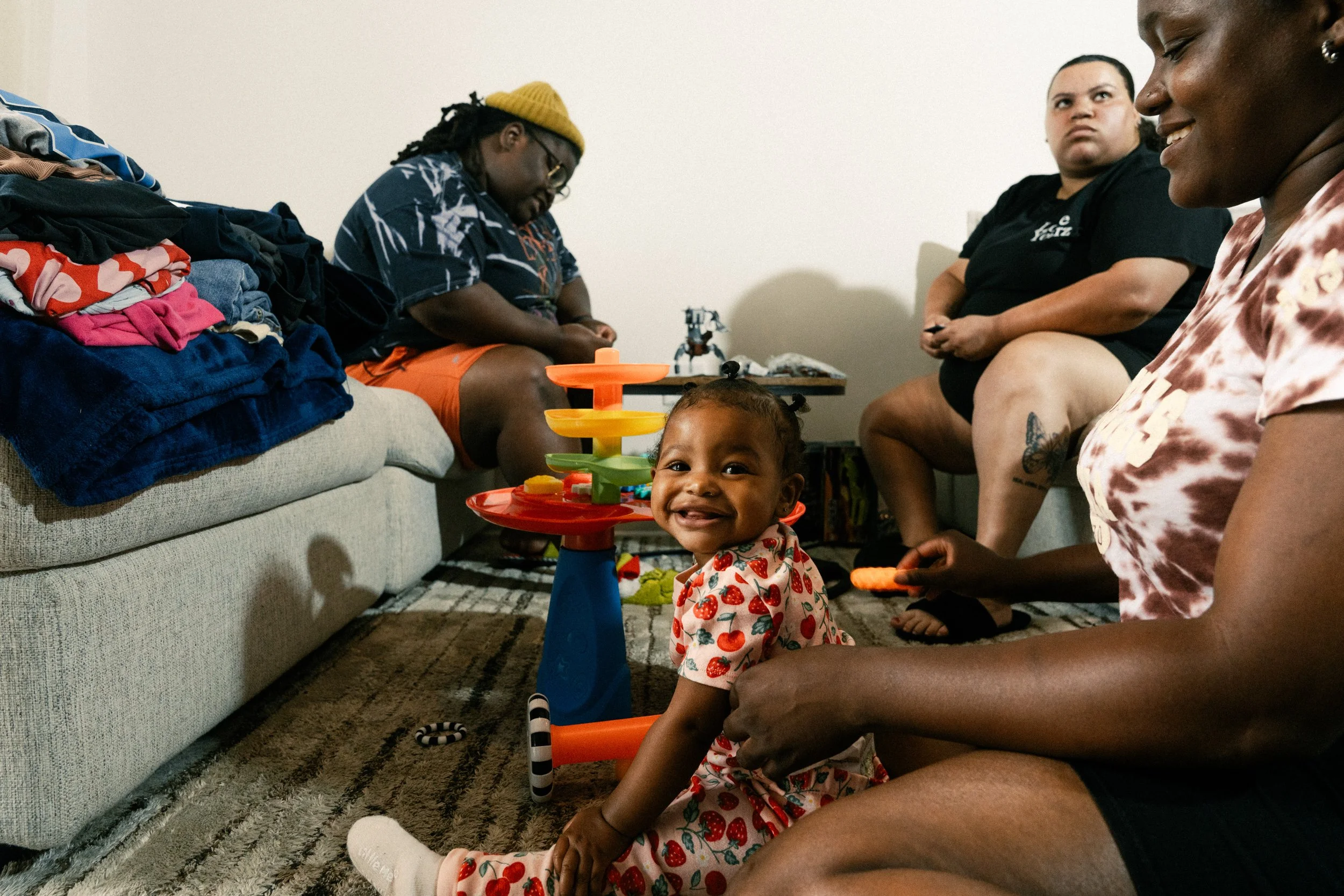
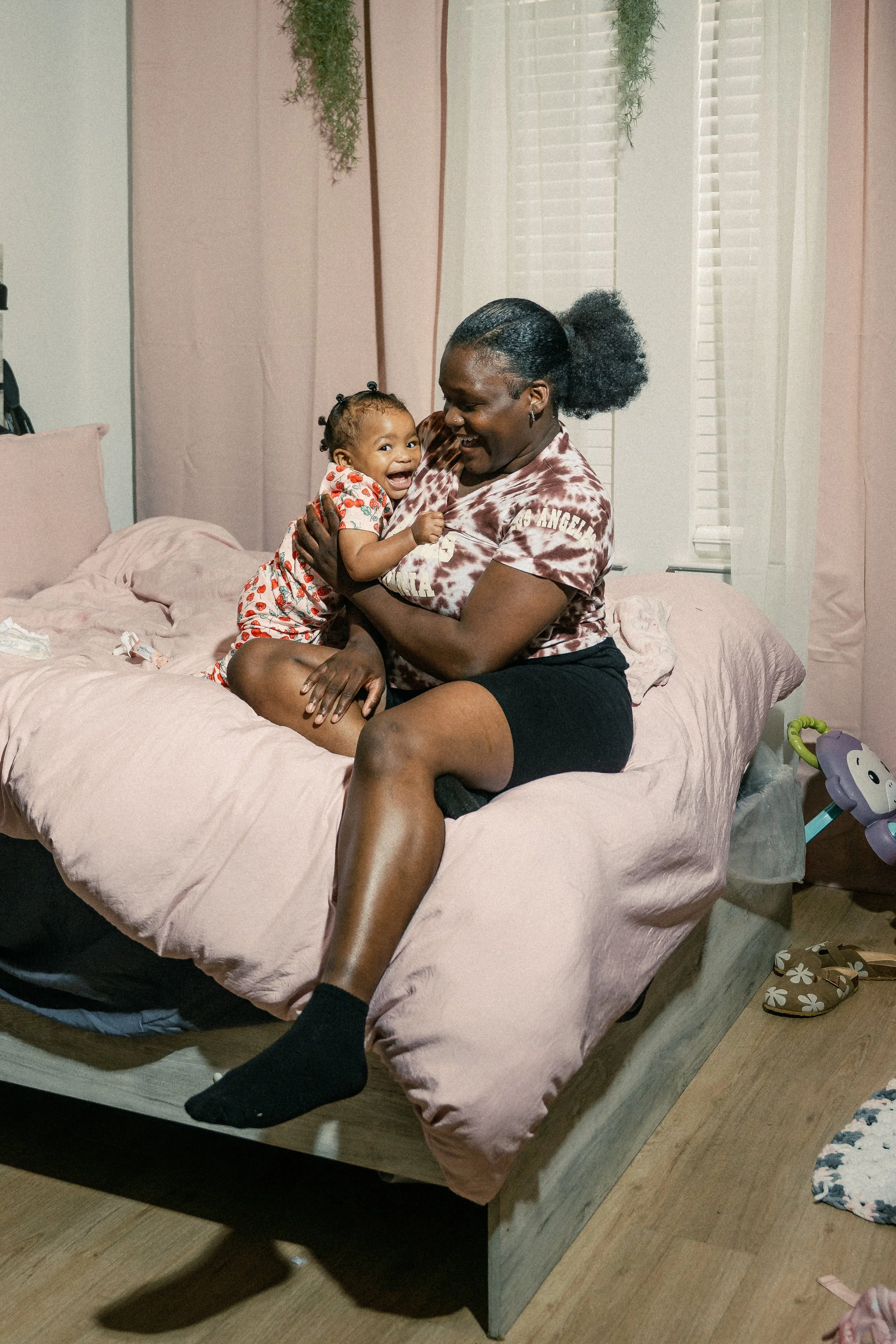
Inside the apartment, things become clear pretty quickly. There are four of them: Aaliyah, Leah, Booda, and Nahla, their one-year-old daughter.
Aalliyah and Leah are a couple, all three adults in their mid-twenties.
It doesn’t follow a traditional format. Not in name, not in roles, not in how it comes together. But it doesn’t feel confusing. It feels settled.
Aalliyah and Booda aren’t related by blood, but they’ve known each other since childhood. Their families were close, and that proximity turned into something that stayed. Not formal, not labeled, just consistent enough over time to become family in practice.
You can feel that history in how they move around each other.
Nahla, Booda’s biological mother, sits at the center of it now, but not in a way that isolates responsibility. She moves between them easily.
There’s very little need to define what this is.
It doesn’t present itself as an alternative. It just works.
What does family look like when it’s built through care, not obligation?
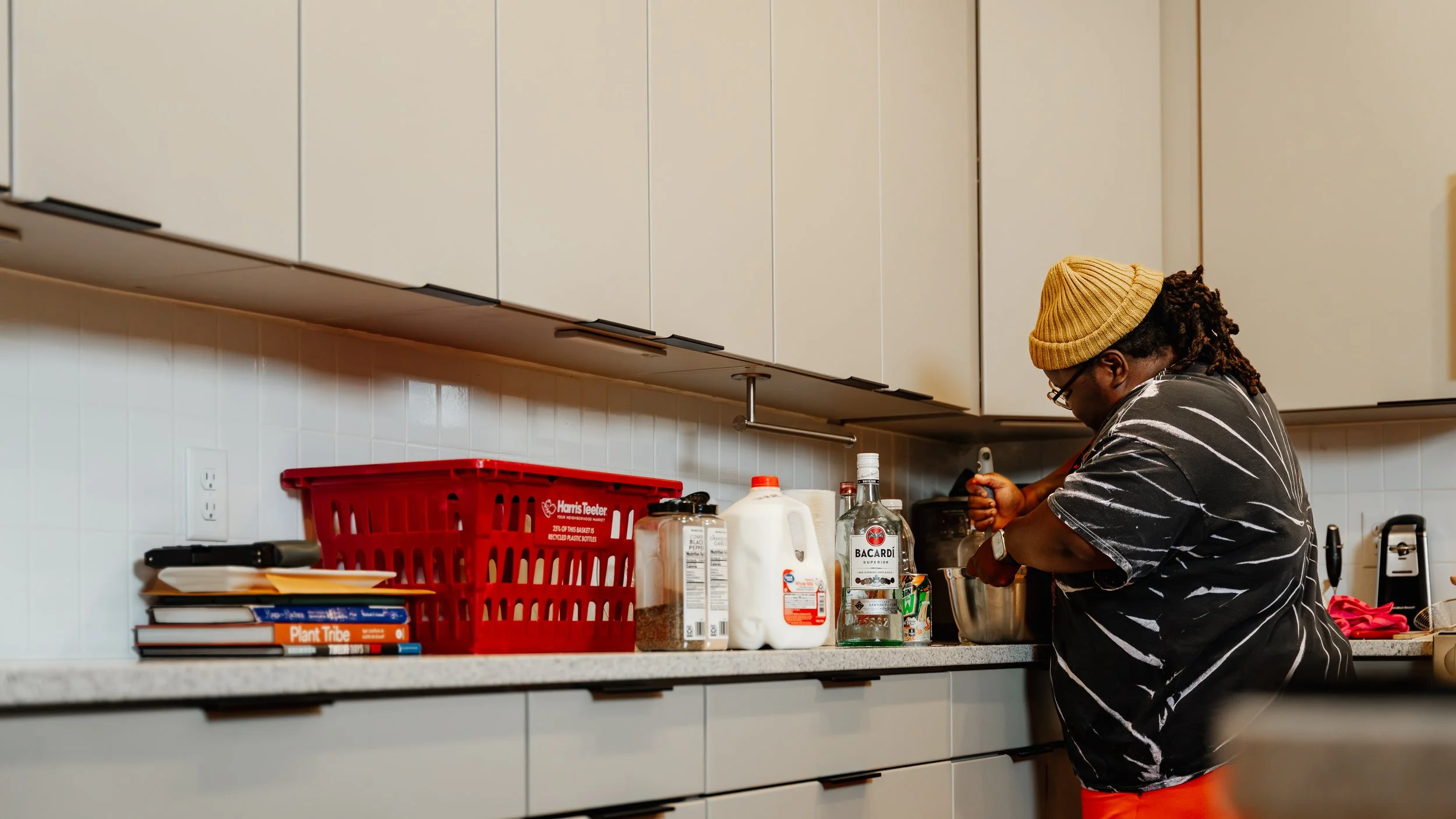
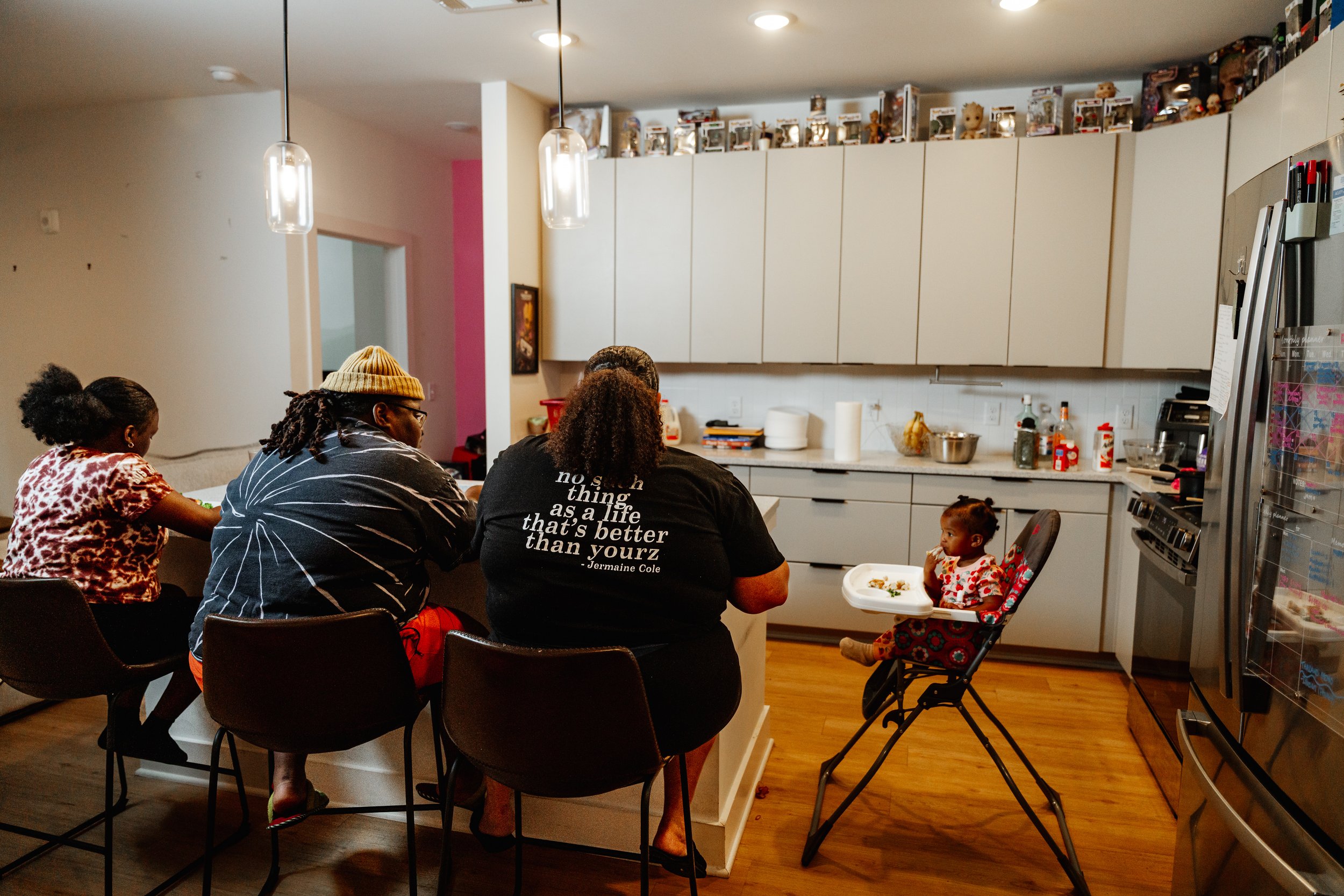
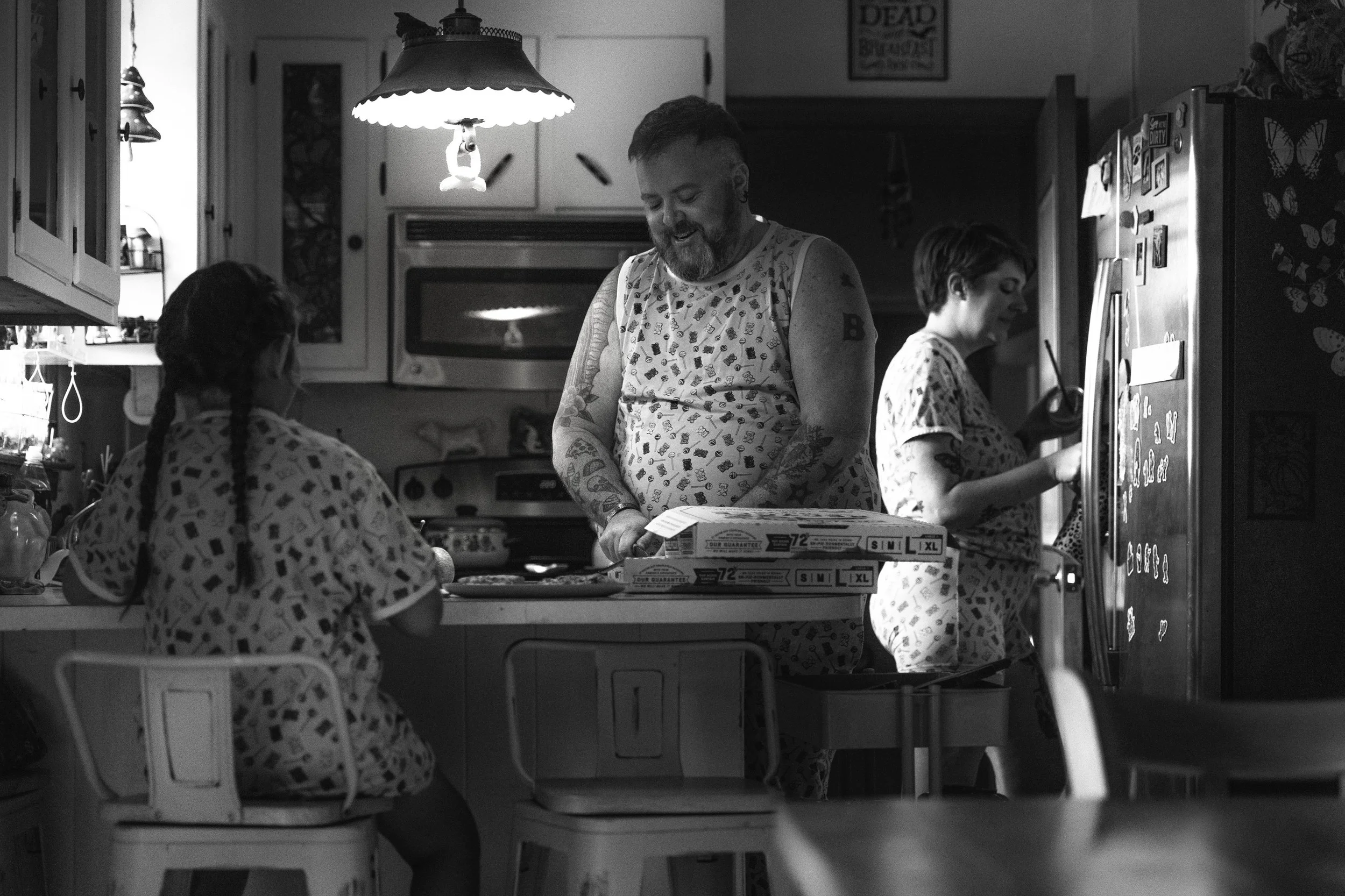
In the kitchen, food gets made when there’s time for it. Not every day, not on a perfect schedule. Work shifts things. Energy shifts things. But the intention stays.
Care moves through the space without needing to be named.
Meals happen when they can. Someone cooks, laundry gets done, Nahla gets fed; the rest flows.
And the next day, the space resets itself.
Then there are the smaller moments.
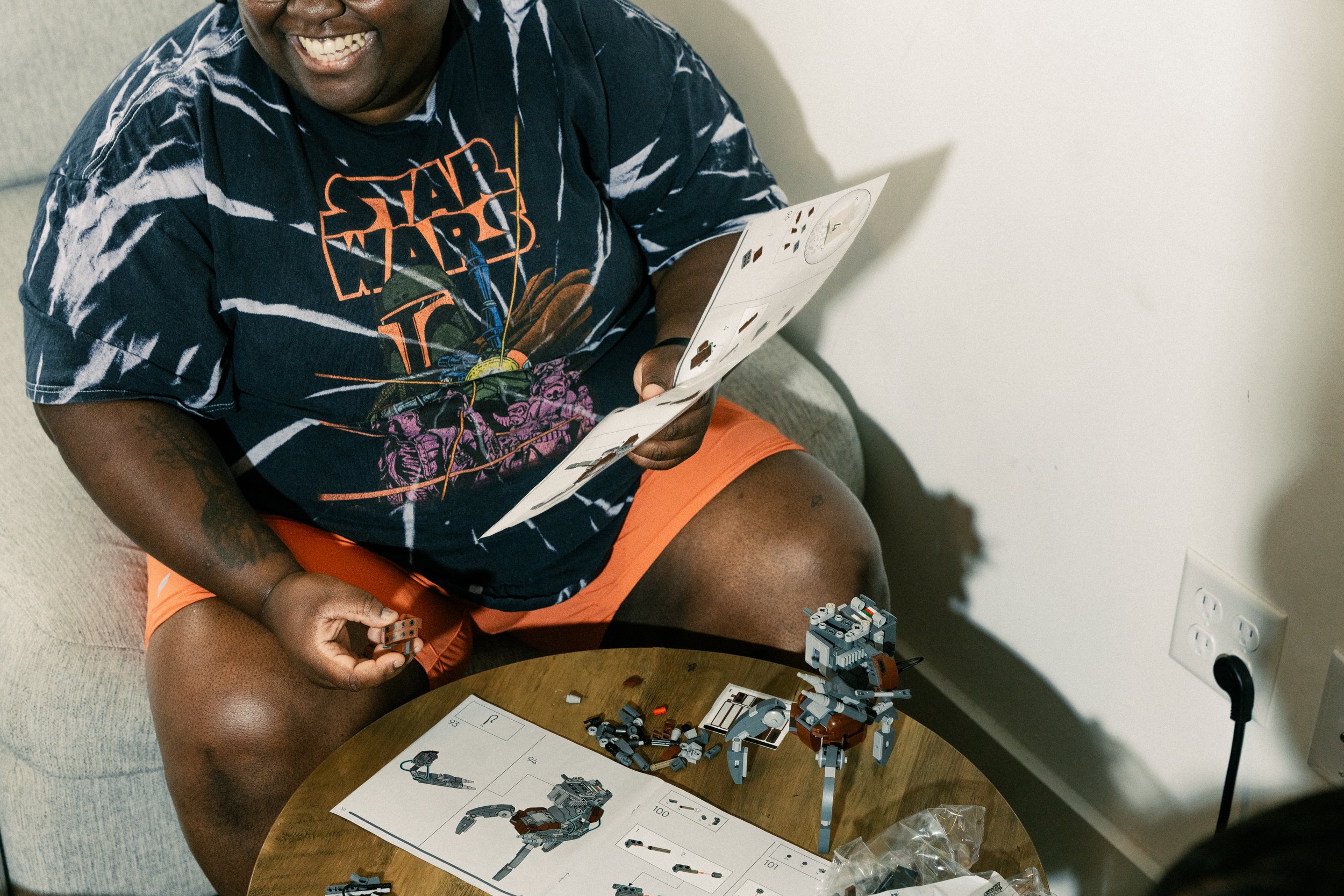
LEGO builds. Gaming. Sitting in the same space doing different things at the same time. Not structured as activities, just ways of being near each other without needing to perform closeness.
Joy shows up in pieces. Something repeatable.
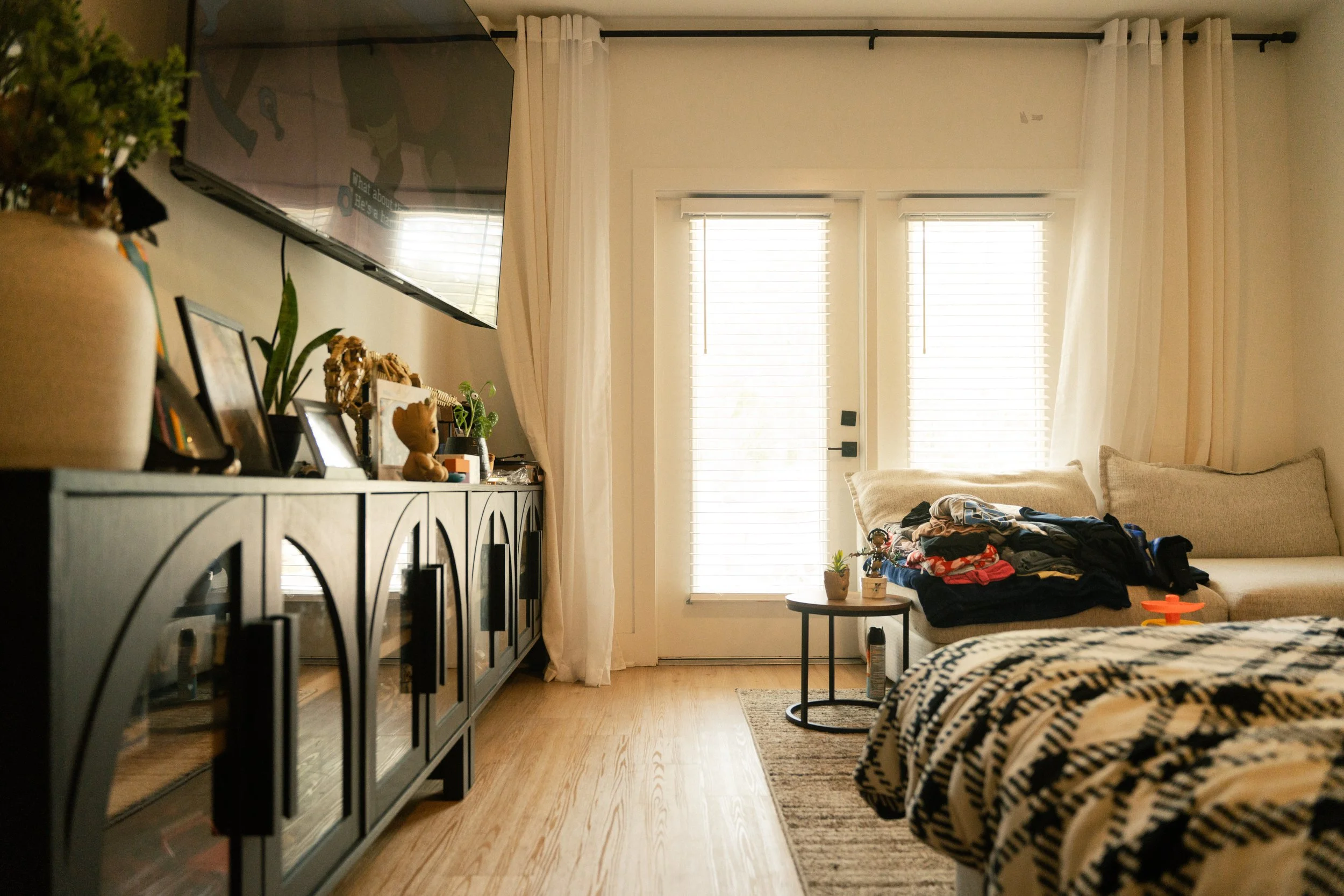
The apartment reflects that back.
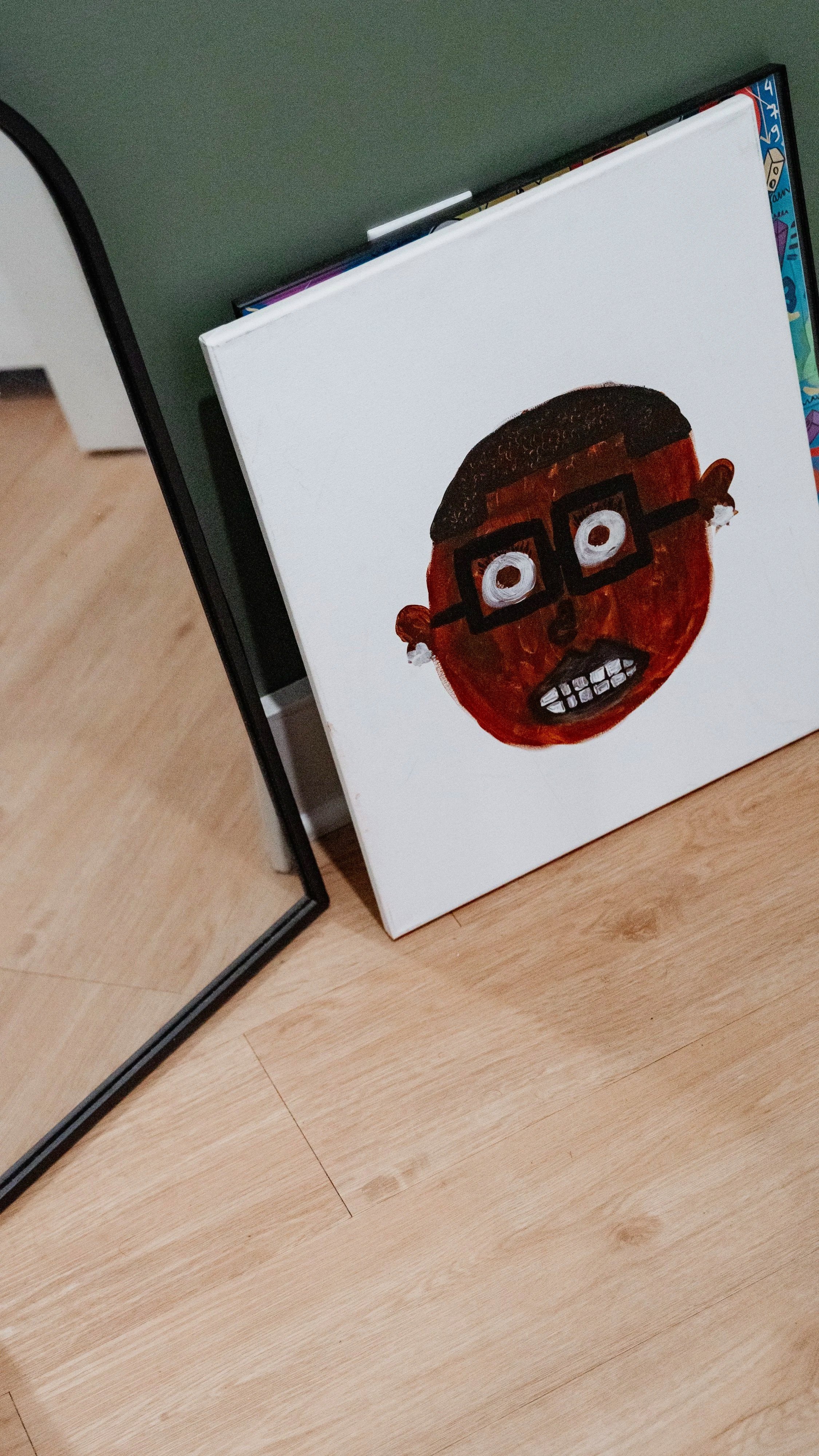
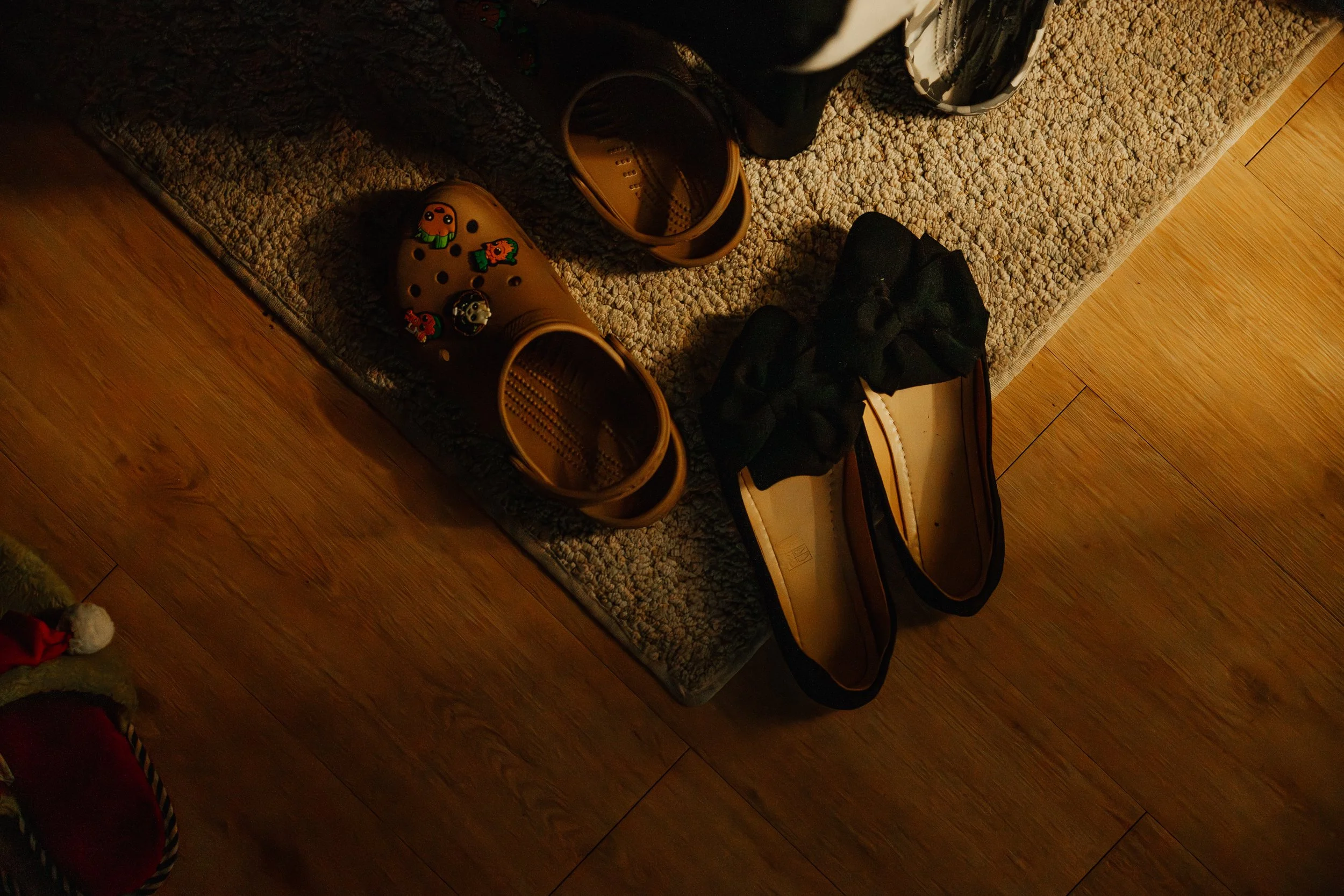
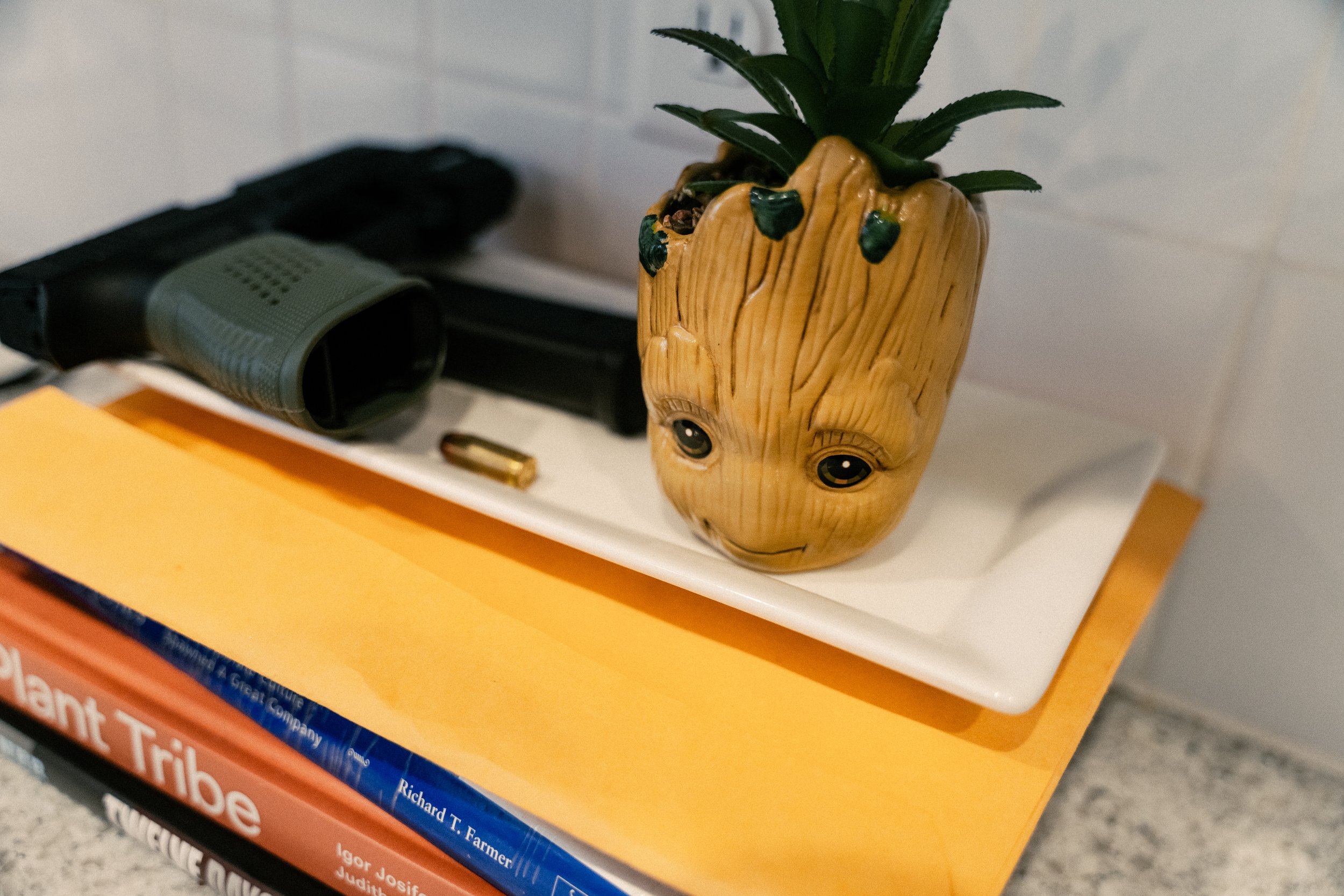
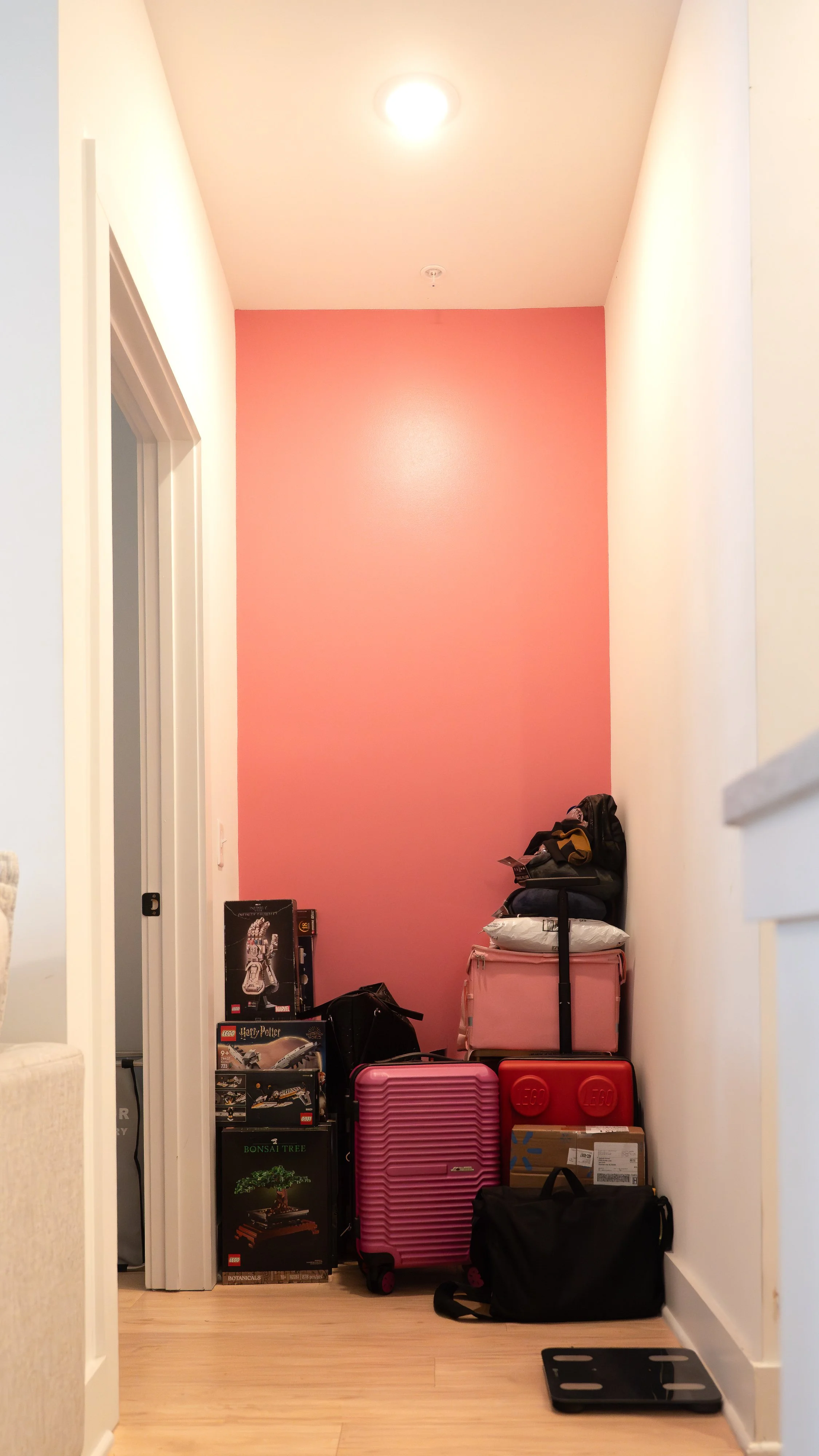
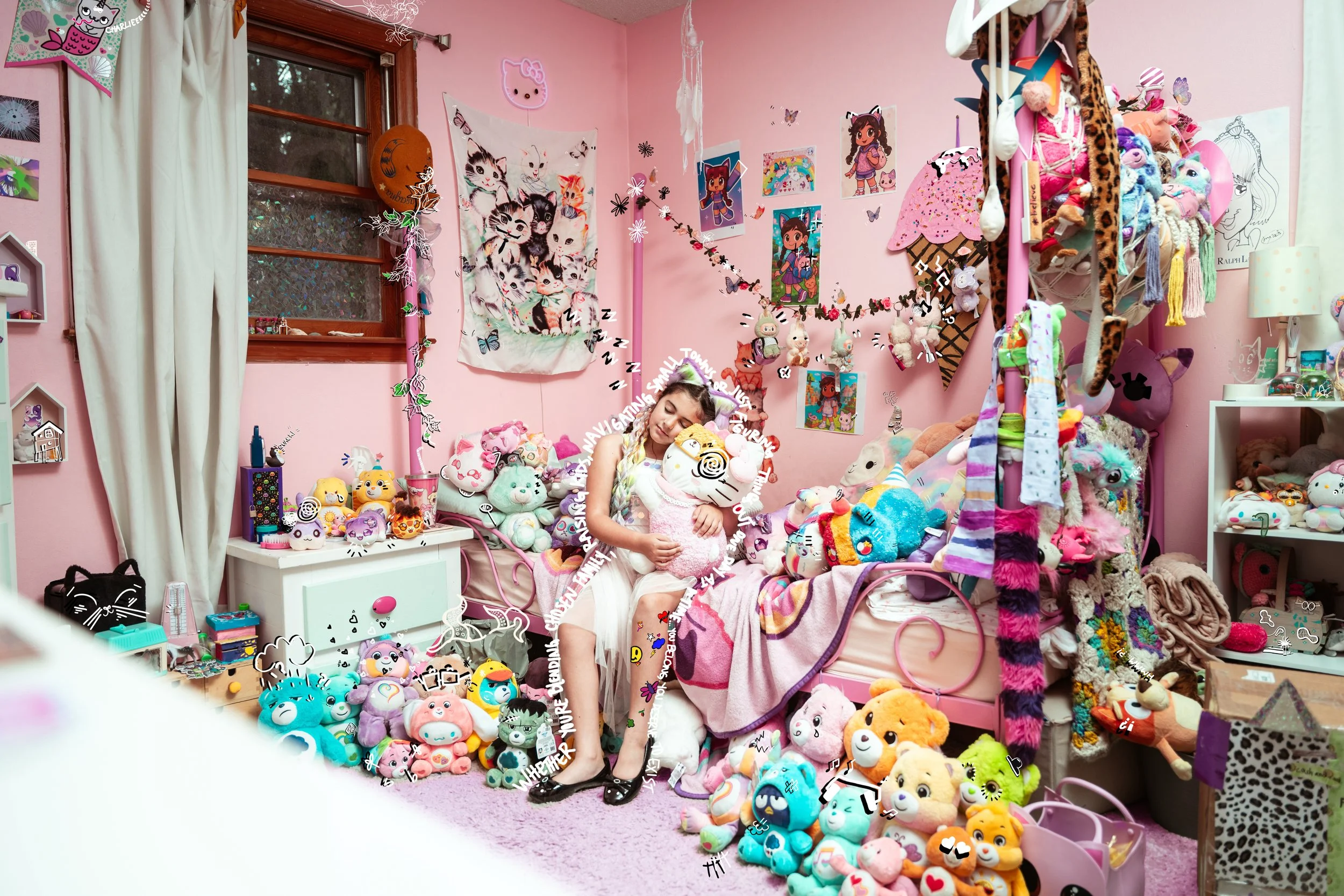
A pink corner that’s yet to be claimed, and objects that don’t match but still make sense together–nothing is trying to look finished.
And that’s enough.
What stands out isn’t just how the household is structured, or how care moves through it. It’s how fully it exists.
There’s no sense of waiting for the environment to catch up.
Outside, everything feels planned but not fully lived in.
Inside, that question disappears.
The space is active. Specific. Claimed. Every room reflects use.
A queer household, multi-adult, raising a child together. Visible, but not performing visibility.
Even the quieter moments hold that.
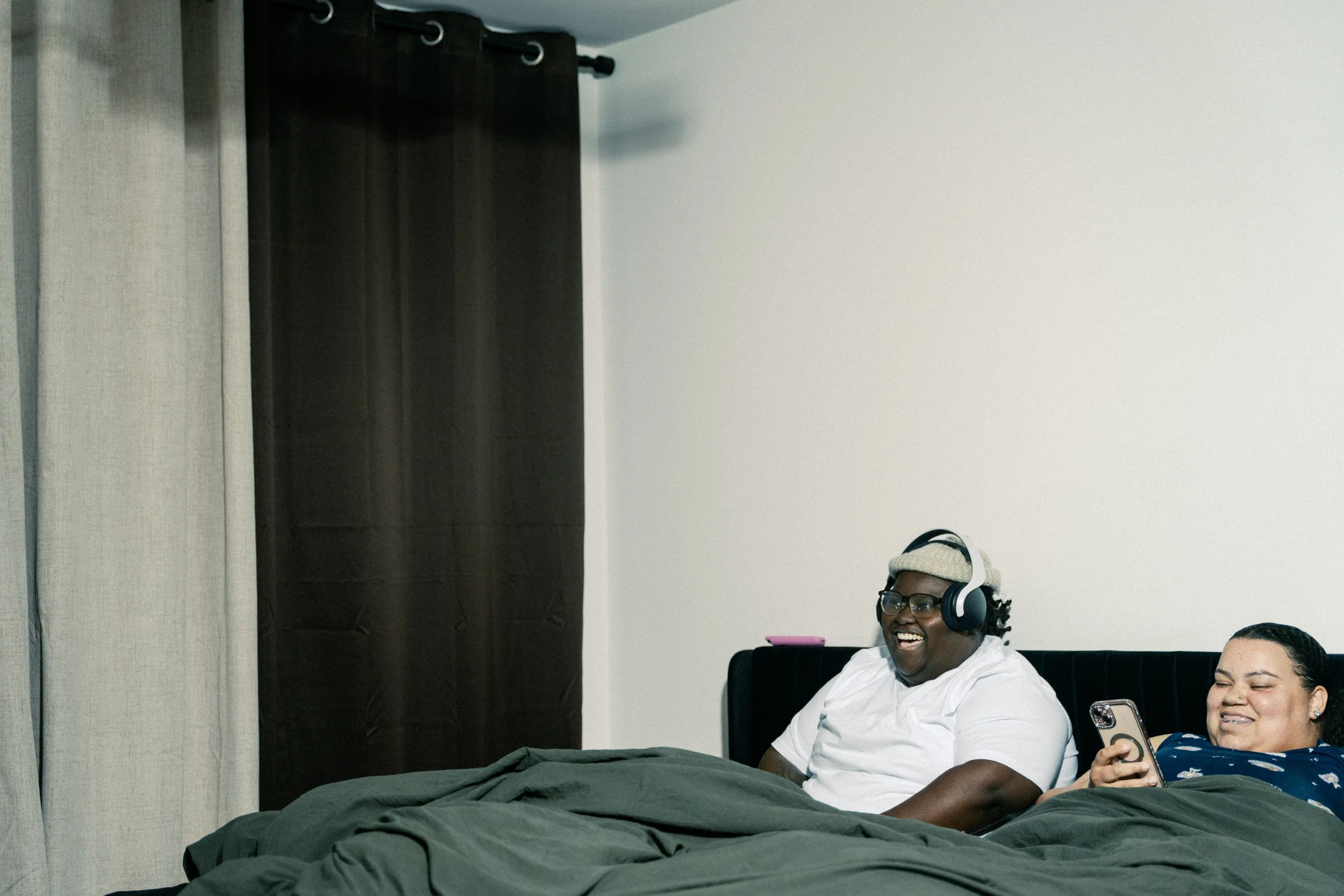
Different rhythms in the same room. One person resting, another still awake. Proximity without performance.
Nahla moves through all of it, not as a point of pressure, but as a point of continuity.
In the South, where ideas of family are often already defined, this household moves differently. It doesn’t reject those expectations. It simply exists outside of them.
What’s happening here doesn’t feel tentative.
It’s already in place, because they chose each other.
and because they chose love.
A Place of Our Owncontinues to grow through the families who take part in it. If this feels familiar, or if there’s a household you think belongs in this project, you can reach out or nominate them here.
THE GREENBERGS Kris, Nicole, and Talia North Charleston, SC | July 2025
Can you be radically queer and also traditionally domestic? Can you be Southern without the weight of its history defining you?
The Greenbergs live in the space between these questions.
Between tradition and rebellion;
between cultural inheritance and chosen family, between what is softened for safety, and what is protected at all costs.
It is a paradox I recognize in myself. The pull toward home, toward familiarity, toward the language and rituals that shaped me, alongside a resistance to being contained by them. Queer life in the South often requires negotiation. What we reveal, what we keep, what we learn to hold quietly so it cannot be taken.
This work lives inside that tension. I am not interested in defining what queer families look like. I am asking what they could look like if relief, joy, and self-expression were not treated as risks.
How much of our joy, of our style, our very selves, are we still holding back?
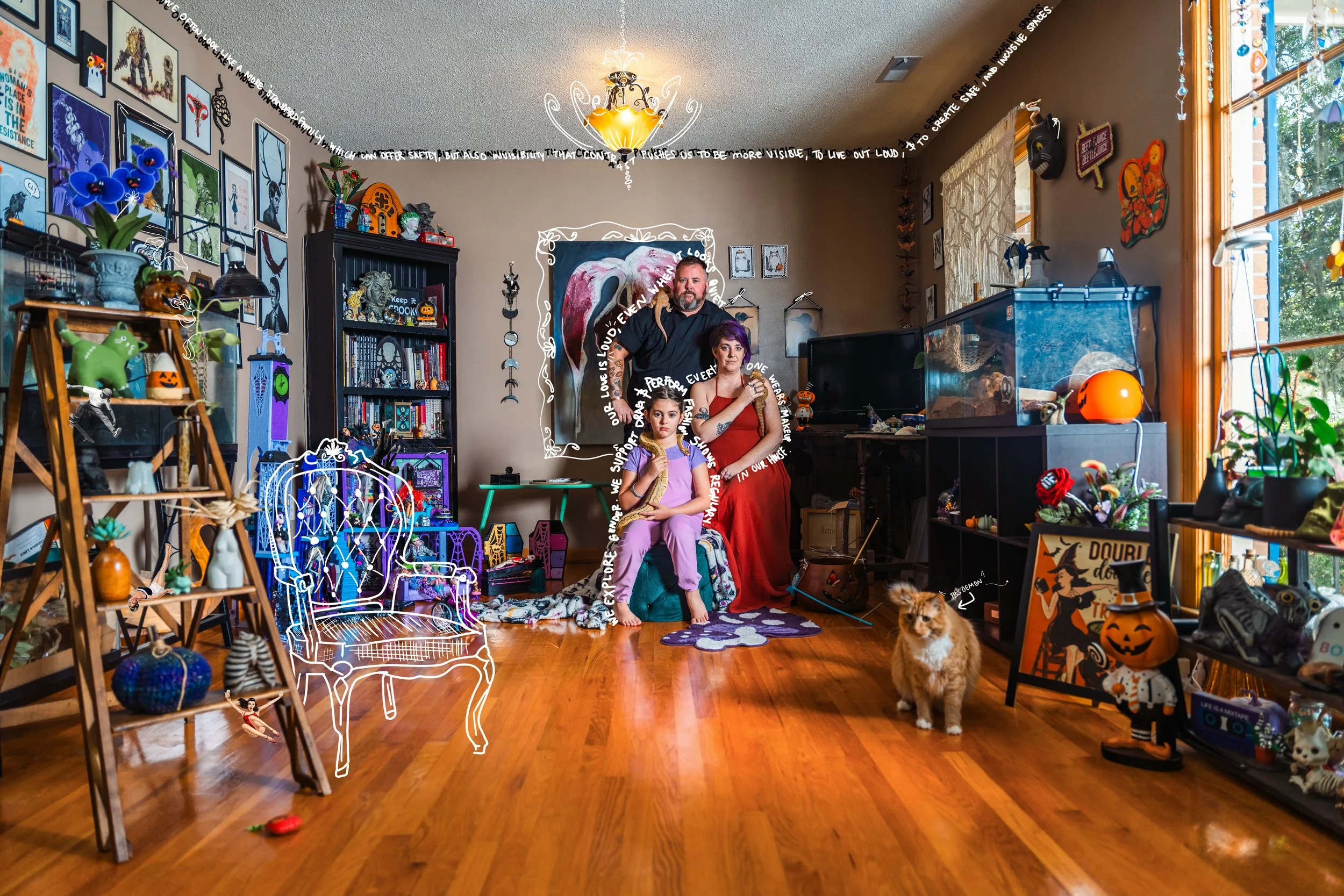
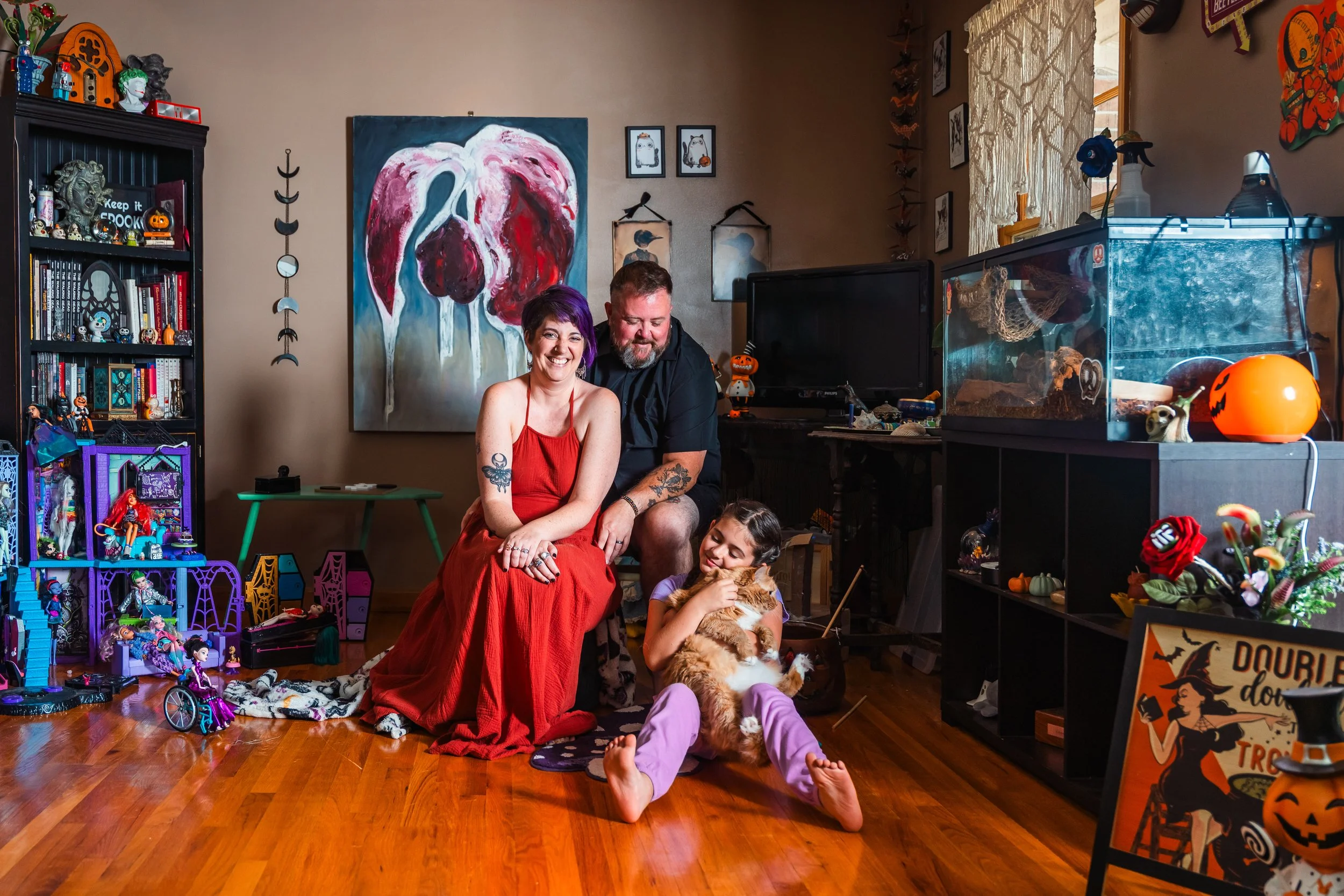
This entry in A Place of Our Own documents the Greenberg family – Nicole, Kris, and their daughter Talia, inside a home that feels less like a house and more like a portal. Part Halloween town, part queer cave. The space is playful, tender, and intentional. Spookiness coexists with care. Love appears not as spectacle, but as atmosphere. Here, domesticity is not a retreat from queerness. It is an extension of it.
What happens when home becomes an act of resistance?
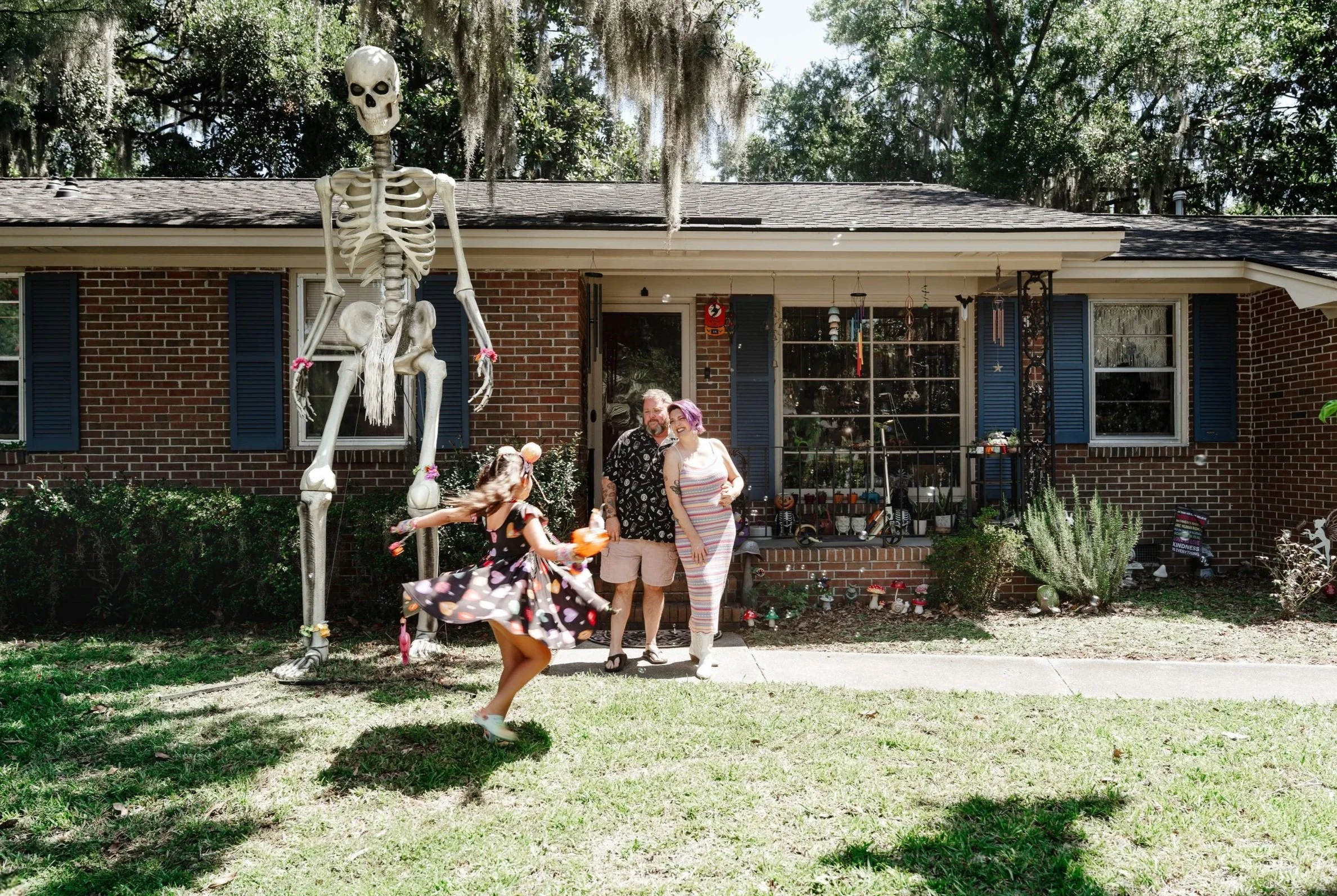
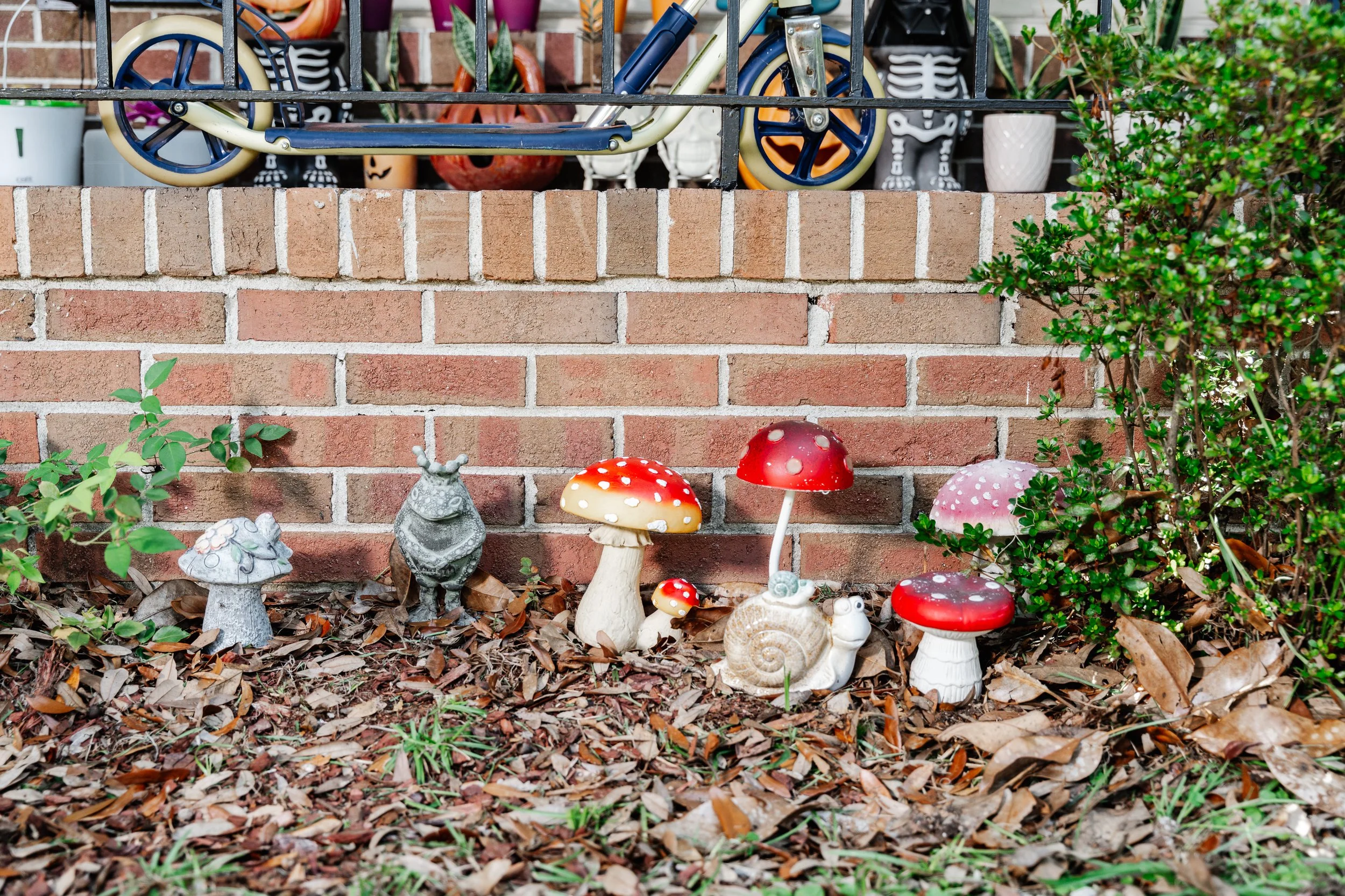
This is a queer family in the South, moving through visibility, passing, and pride with both contrast and courage. The front yard is watched over by a towering skeleton named John, a campy, welcoming figure that greets visitors year-round and sets the tone immediately. The home signals playfulness before you ever step inside.
Inside, the space becomes something deeper.
A place of emotional safety and playful experimentation, where gender is understood as a spectrum, where makeup is worn freely, and where brinner, breakfast for dinner, is sacred. It is a home where Talia, eight, can grow into herself without judgment. A home where the message is simple and consistent – “You can always come home.”
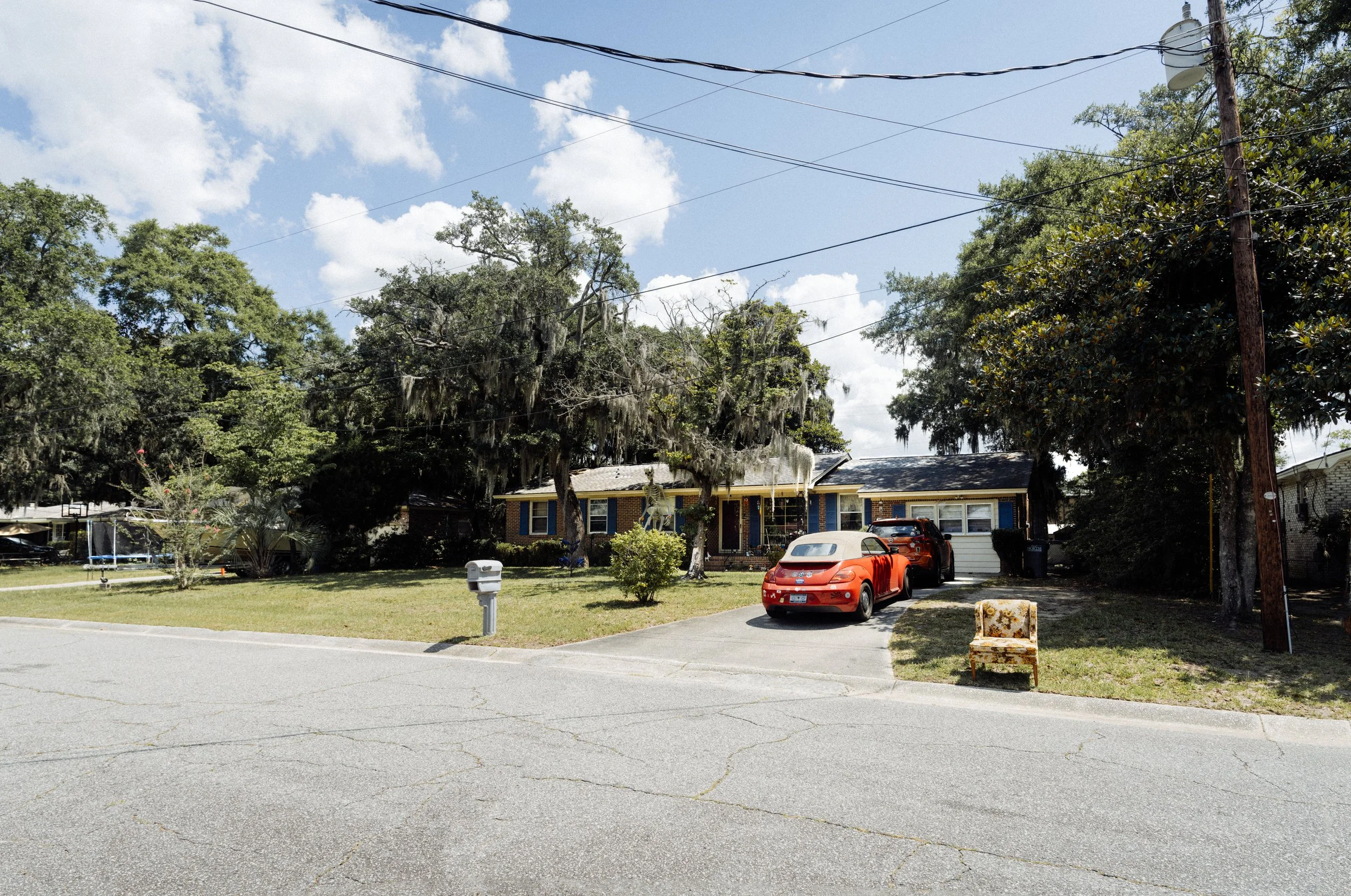
Nicole, Kris, and Talia moved into their North Charleston home in February 2023 after feeling priced out of Park Circle, a neighborhood that, like many across the South, has undergone rapid change. Originally built for working-class residents tied to the naval base, Park Circle has seen rising home values, an influx of higher-income residents, and noticeable demographic shifts over the past decade. What once felt accessible and community-driven has, for many, become increasingly expensive and harder to inhabit without compromise.
When Nicole first saw the mid-century ranch with the purple door, she knew. Inside, the house feels unmistakably theirs, shaped slowly through intention rather than trend.
The Greenbergs do not fit a mold. They have built something better, something true to them. Their world is joyful, chaotic, and deeply loving. In a region where queer families often walk a careful line between safety and erasure, their home stands as a glowing example of what it means to live freely and without apology.
This work is not just portraiture. It is testimony. It is an invitation. A reminder that love, when allowed to be expressive and uncontained, becomes its own form of protest. And its own form of celebration.
Every day is Halloween here.
Every trinket, every wall hanging, every furry or scaly creature carries intention. The space feels soft and specific—spooky, yes, but also warm. Nothing is accidental. Nothing is hidden. The weirdness isn’t tucked away; it’s celebrated openly. This is exactly the kind of home I hoped to find when I began this series.
The pets are part of the family’s story, too.
Pretzel the snake. Gretchen Wieners, the sorta-wiener dog. Macaroni—lovingly referred to as a piss demon and a master of destroying curated vintage furniture. Elder cats Rumors and Misty, outdoor queens by tenure alone. Dolly Parton and Kenny Rogers, the lizards, perpetually unimpressed and deeply horny.
Together, they form a living ecosystem—messy, funny, affectionate, and deeply alive.
Inside, the house reveals itself slowly.
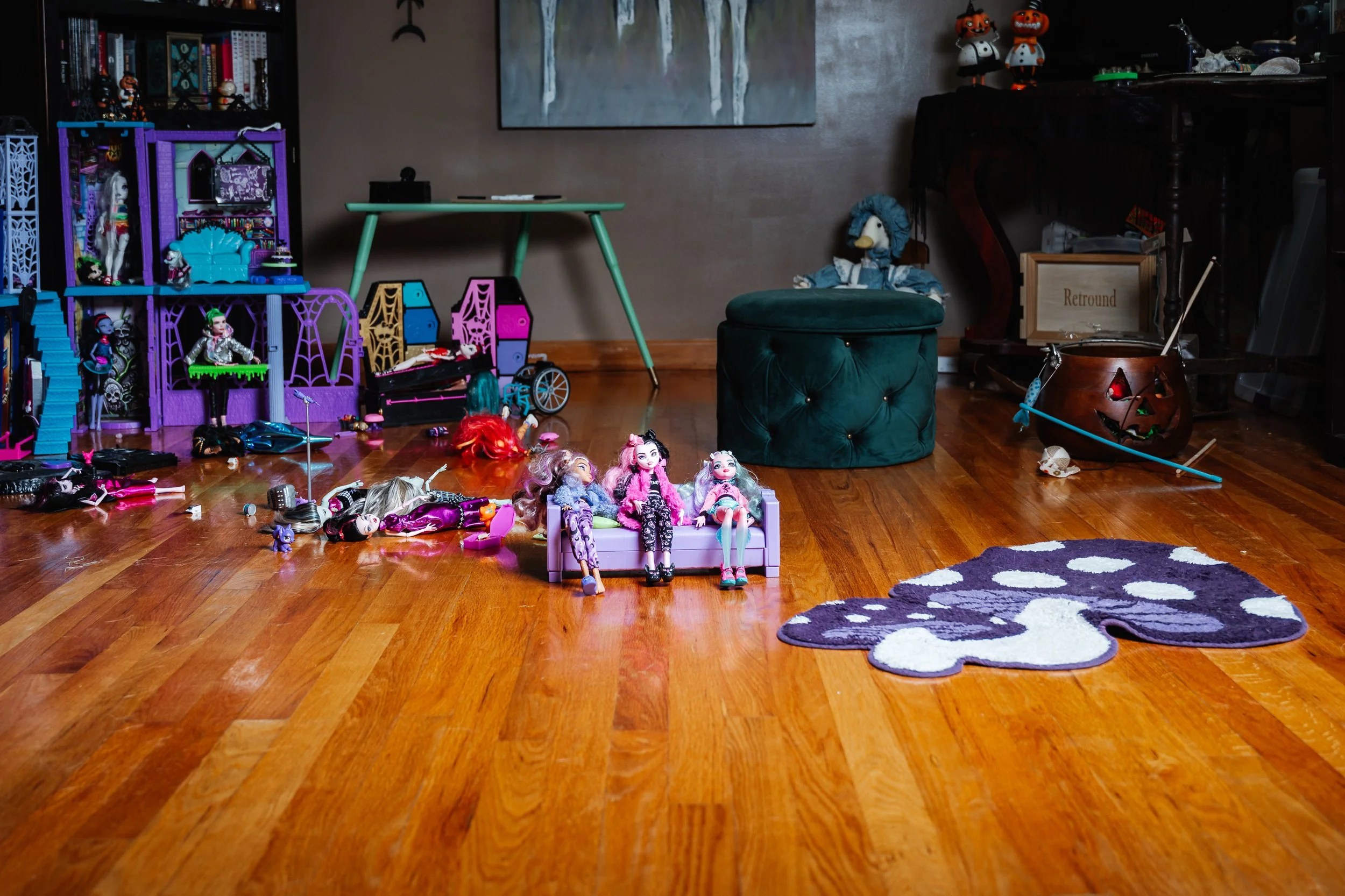
Dim, layered, and gentle, it feels like stepping into a space stitched together from hand-me-downs, memory, and care. The front room holds their love of art, creatures, and all things spooky. A curated collection of books and trinkets lives alongside a soft-lit altar, a full Monster High shrine, and castle-shaped coffins tucked in quietly.
Much of their favorite time together comes from shared ritual—crafting, building, storytelling, and long movie nights. Art projects, baking experiments, thrift store treasure hunts, and stretches of being delightfully goofy around the house. There are monthly date nights, bedtime book readings, and a standing house rule: anyone is always allowed to sing or dance.
They put on fashion shows using whatever is nearby—new thrift finds, old staples, elaborate accessories, improvised makeup. Music plays loudly. Dancing happens in hallways.
The house responds.
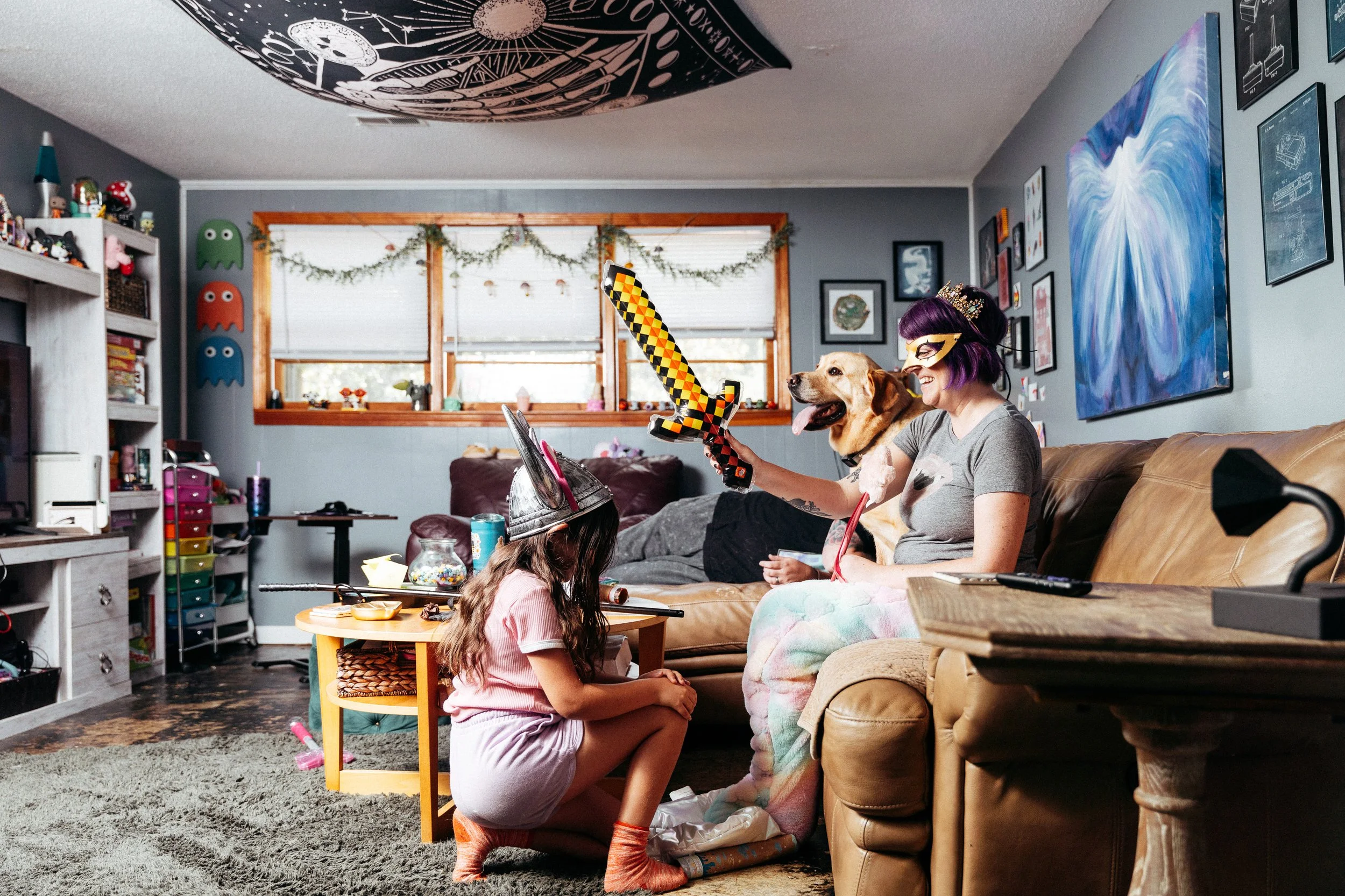
The living room dips slightly below the rest of the home, forming a natural nest for snuggling, game nights, and horror marathons. The dogs usually claim the best seat. The shadows feel intentional, part of the design rather than something to be corrected.
The kitchen is softer, more grounded. Heirloom furniture sits beside practical pieces with history. A converted desk from Nicole’s aunt now serves as a custom bar, holding both function and lineage.
Every corner of the house carries layered meaning. Spiritual grounding lives comfortably beside play, joy, and personal mythology.
Their home does not simply reflect their family’s personality. It is their personality.
Talia leads the charge with endless ideas, her parents always willing to follow her spark.
When I asked what she’s into right now, the answer unfolded in layers: The Cherry Cola Labubu, cats….always, crafting vending machines she made out of cardboard, tiny goodie bags too, Monster High dolls, Rock Band, Minecraft, fashion shows, scary movies (whenever allowed). She’s wildly creative and deeply hands-on, already using fashion and décor as tools for self-expression.
Conversations around identity, gender, and queerness have never been framed as singular moments in this home. They are part of the everyday language of care. Talia understands gender as a spectrum and moves through difference with ease, curiosity, and respect. For Nicole and Kris, this isn’t something they teach through instruction, but through example. It’s visible in how they listen, how they respond, and how they make space.
Talia has taught Nicole and Kris as much as they have taught her. Through her eyes, they’ve rediscovered curiosity, invention, and imagination without limits. She reminds them to slow down, to play more, and to approach the world with softness. When they speak about hope, you feel it immediately.
The hope that she will always know she can come home.
The house holds this philosophy quietly. It isn’t built around spectacle, but around consistency and intention. Parenting here is an act of presence, built through ritual: Halloween costumes, hallway fashion shows, spontaneous dance breaks, and, of course, brinner.
Being a queer family in the South means living with both contrast and courage.
Since Kris transitioned before he and Nicole met, their life together has always been open and intentional. From the outside, they can be read as a “traditional” straight family. That reading comes with safety, but it also brings a quieter kind of erasure. Visibility becomes conditional. Belonging can feel partial.
They both come from more liberal places, and they carry that perspective into how they move through South Carolina. It strengthens their perspective, deepens their resilience, and reinforces their bond.
It’s why their parenting is rooted in emotional safety, creativity, and joy. It’s why their home looks and feels the way it does.
Their presence—both in their neighborhood and within this project—matters because it resists easy categorization.
“We’re not the nuclear family. Far from it. We explore gender. We support drag and perform fashion shows regularly. Everyone wears makeup in our house. And we’ve worked hard to build the unit we have. It’s not biological, but it’s exactly how it’s supposed to be.”
If this work ever finds its way into Talia’s future photo album, the message they would want it to carry is simple:
Things are not picture-perfect. But they are fun, chaotic, and ours.
The Greenbergs show us that the answer is yes.
You can be radically queer and deeply domestic. You can be unmistakably Southern and entirely your own. Home does not have to look a certain way to be real. Family does not need to follow a single script to be valid.
What they offer is not a blueprint, but a sense of possibility—a reminder to other queer families in the South, especially those still finding their footing, that there is no one correct way to belong.
“It’s okay if your family doesn’t look loud or political—or if it does. There’s no one way to be a queer family. Whether you’re blending chosen family, raising kids, navigating small towns, or just figuring things out one day at a time… you belong, and you deserve to exist.
Find your moments of magic. Make art. Celebrate weirdness. Be soft when you can, and fierce when you need to be. Your love, your joy, and your story are radical acts in themselves.”
This work is about noticing those moments—the small rituals, the softness, the joy that survives. The homes we build when we are allowed to do so honestly.
A Place of Our Own is an ongoing photo series. If this story resonates with you, submissions are open for queer families across the South. You may nominate your own household, or another family you believe should be part of this archive, here.
A Place of Our Own challenges the assumption that queerness and domesticity are mutually exclusive,
asking what it means to raise a family with both radical visibility + Southern tradition.
What is A Place of Our Own?
A Place of Our Own is a photo series about queer families in the South. It documents the ways we live, love, and build home—through portraiture, storytelling, and the everyday. Each shoot takes place inside the family’s space, with a focus on rituals, aesthetics, care, and chaos. It’s about domestic life without the filter of normativity.
Why?
Because queerness and domesticity aren’t opposites. Because the South is full of queer people making life work in ways that aren’t always visible. Because home can be a site of both safety and protest. This project exists to archive, celebrate, and complicate what it means to be radically queer and deeply rooted.
Family portrait · Summerville, SC | April 2026
THREE BITCHES & A BABY
Aalliyah, Leah, Booda, and Nahla
What does family look like? How do people create intimacy inside systems built for sameness?
On the way in, I begin to notice repetition.
New builds, new apartments, new strip malls. Grocery stores facing each other across oversized parking lots. Rows of homes that feel placed rather than grown. It’s clean, modern, and clearly intentional, but not yet fully inhabited.
This area is part of Nexton, a large master-planned community about 25 miles outside Charleston, near Summerville. Built in phases, it brings housing, schools, workplaces, and everyday life together, creating a complete community from the ground up.
It sits on land that was previously undeveloped, part of a larger push to expand outward from Charleston as the region grows. Instead of forming gradually, everything here is being constructed at once, guided by a central plan.
You can feel that planning immediately–wide sidewalks, rows of developing homes, and commercial real estate.
It carries a version of Carolina charm, but for now, it’s thin, layered over something more engineered. Like a place that knows what it’s supposed to be, but hasn’t fully become it yet.
It’s all still in progress. As I approach the home, a similar sense of intention begins to carry inside.
Inside the apartment, things become clear pretty quickly. There are four of them: Aaliyah, Leah, Booda, and Nahla, their one-year-old daughter.
Aalliyah and Leah are a couple, all three adults in their mid-twenties.
It doesn’t follow a traditional format. Not in name, not in roles, not in how it comes together. But it doesn’t feel confusing. It feels settled.
Aalliyah and Booda aren’t related by blood, but they’ve known each other since childhood. Their families were close, and that proximity turned into something that stayed. Not formal, not labeled, just consistent enough over time to become family in practice.
You can feel that history in how they move around each other.
Nahla, Booda’s biological mother, sits at the center of it now, but not in a way that isolates responsibility. She moves between them easily.
There’s very little need to define what this is.
It doesn’t present itself as an alternative. It just works.
What does family look like when it’s built through care, not obligation?
In the kitchen, food gets made when there’s time for it. Not every day, not on a perfect schedule. Work shifts things. Energy shifts things. But the intention stays.
Care moves through the space without needing to be named.
Meals happen when they can. Someone cooks, laundry gets done, Nahla gets fed; the rest flows.
And the next day, the space resets itself.
Then there are the smaller moments.
LEGO builds. Gaming. Sitting in the same space doing different things at the same time. Not structured as activities, just ways of being near each other without needing to perform closeness.
Joy shows up in pieces. Something repeatable.
The apartment reflects that back.
A pink corner that’s yet to be claimed, and objects that don’t match but still make sense together–nothing is trying to look finished.
And that’s enough.
What stands out isn’t just how the household is structured, or how care moves through it. It’s how fully it exists.
There’s no sense of waiting for the environment to catch up.
Outside, everything feels planned but not fully lived in.
Inside, that question disappears.
The space is active. Specific. Claimed. Every room reflects use.
A queer household, multi-adult, raising a child together. Visible, but not performing visibility.
Even the quieter moments hold that.
Different rhythms in the same room. One person resting, another still awake. Proximity without performance.
Nahla moves through all of it, not as a point of pressure, but as a point of continuity.
In the South, where ideas of family are often already defined, this household moves differently. It doesn’t reject those expectations. It simply exists outside of them.
What’s happening here doesn’t feel tentative.
It’s already in place, because they chose each other.
and because they chose love.
A Place of Our Owncontinues to grow through the families who take part in it. If this feels familiar, or if there’s a household you think belongs in this project, you can reach out or nominate them here.
Family portrait · North Charleston, SC | July 2025
THE GREENBERGS
Kris, Nicole, and Talia
Can you be radically queer and also traditionally domestic? Can you be Southern without the weight of its history defining you?
The Greenbergs live in the space between these questions.
Between tradition and rebellion;
between cultural inheritance and chosen family, between what is softened for safety, and what is protected at all costs.
It is a paradox I recognize in myself. The pull toward home, toward familiarity, toward the language and rituals that shaped me, alongside a resistance to being contained by them. Queer life in the South often requires negotiation. What we reveal, what we keep, what we learn to hold quietly so it cannot be taken.
This work lives inside that tension. I am not interested in defining what queer families look like. I am asking what they could look like if relief, joy, and self-expression were not treated as risks.
How much of our joy, of our style, our very selves, are we still holding back?
This entry in A Place of Our Own documents the Greenberg family – Nicole, Kris, and their daughter Talia, inside a home that feels less like a house and more like a portal. Part Halloween town, part queer cave. The space is playful, tender, and intentional. Spookiness coexists with care. Love appears not as spectacle, but as atmosphere. Here, domesticity is not a retreat from queerness. It is an extension of it.
What happens when home becomes an act of resistance?
This is a queer family in the South, moving through visibility, passing, and pride with both contrast and courage. The front yard is watched over by a towering skeleton named John, a campy, welcoming figure that greets visitors year-round and sets the tone immediately. The home signals playfulness before you ever step inside.
Inside, the space becomes something deeper.
A place of emotional safety and playful experimentation, where gender is understood as a spectrum, where makeup is worn freely, and where brinner, breakfast for dinner, is sacred. It is a home where Talia, eight, can grow into herself without judgment. A home where the message is simple and consistent – “You can always come home.”
Nicole, Kris, and Talia moved into their North Charleston home in February 2023 after feeling priced out of Park Circle, a neighborhood that, like many across the South, has undergone rapid change. Originally built for working-class residents tied to the naval base, Park Circle has seen rising home values, an influx of higher-income residents, and noticeable demographic shifts over the past decade. What once felt accessible and community-driven has, for many, become increasingly expensive and harder to inhabit without compromise.
When Nicole first saw the mid-century ranch with the purple door, she knew. Inside, the house feels unmistakably theirs, shaped slowly through intention rather than trend.
The Greenbergs do not fit a mold. They have built something better, something true to them. Their world is joyful, chaotic, and deeply loving. In a region where queer families often walk a careful line between safety and erasure, their home stands as a glowing example of what it means to live freely and without apology.
This work is not just portraiture. It is testimony. It is an invitation. A reminder that love, when allowed to be expressive and uncontained, becomes its own form of protest. And its own form of celebration.
Every day is Halloween here.
Every trinket, every wall hanging, every furry or scaly creature carries intention. The space feels soft and specific—spooky, yes, but also warm. Nothing is accidental. Nothing is hidden. The weirdness isn’t tucked away; it’s celebrated openly. This is exactly the kind of home I hoped to find when I began this series.
The pets are part of the family’s story, too.
Pretzel the snake. Gretchen Wieners, the sorta-wiener dog. Macaroni—lovingly referred to as a piss demon and a master of destroying curated vintage furniture. Elder cats Rumors and Misty, outdoor queens by tenure alone. Dolly Parton and Kenny Rogers, the lizards, perpetually unimpressed and deeply horny.
Together, they form a living ecosystem—messy, funny, affectionate, and deeply alive.
Inside, the house reveals itself slowly.
Dim, layered, and gentle, it feels like stepping into a space stitched together from hand-me-downs, memory, and care. The front room holds their love of art, creatures, and all things spooky. A curated collection of books and trinkets lives alongside a soft-lit altar, a full Monster High shrine, and castle-shaped coffins tucked in quietly.
Much of their favorite time together comes from shared ritual—crafting, building, storytelling, and long movie nights. Art projects, baking experiments, thrift store treasure hunts, and stretches of being delightfully goofy around the house. There are monthly date nights, bedtime book readings, and a standing house rule: anyone is always allowed to sing or dance.
They put on fashion shows using whatever is nearby—new thrift finds, old staples, elaborate accessories, improvised makeup. Music plays loudly. Dancing happens in hallways.
The house responds.
The living room dips slightly below the rest of the home, forming a natural nest for snuggling, game nights, and horror marathons. The dogs usually claim the best seat. The shadows feel intentional, part of the design rather than something to be corrected.
The kitchen is softer, more grounded. Heirloom furniture sits beside practical pieces with history. A converted desk from Nicole’s aunt now serves as a custom bar, holding both function and lineage.
Every corner of the house carries layered meaning. Spiritual grounding lives comfortably beside play, joy, and personal mythology.
Their home does not simply reflect their family’s personality. It is their personality.
Talia leads the charge with endless ideas, her parents always willing to follow her spark.
When I asked what she’s into right now, the answer unfolded in layers: The Cherry Cola Labubu, cats….always, crafting vending machines she made out of cardboard, tiny goodie bags too, Monster High dolls, Rock Band, Minecraft, fashion shows, scary movies (whenever allowed). She’s wildly creative and deeply hands-on, already using fashion and décor as tools for self-expression.
Conversations around identity, gender, and queerness have never been framed as singular moments in this home. They are part of the everyday language of care. Talia understands gender as a spectrum and moves through difference with ease, curiosity, and respect. For Nicole and Kris, this isn’t something they teach through instruction, but through example. It’s visible in how they listen, how they respond, and how they make space.
Talia has taught Nicole and Kris as much as they have taught her. Through her eyes, they’ve rediscovered curiosity, invention, and imagination without limits. She reminds them to slow down, to play more, and to approach the world with softness. When they speak about hope, you feel it immediately.
The hope that she will always know she can come home.
The house holds this philosophy quietly. It isn’t built around spectacle, but around consistency and intention. Parenting here is an act of presence, built through ritual: Halloween costumes, hallway fashion shows, spontaneous dance breaks, and, of course, brinner.
Being a queer family in the South means living with both contrast and courage.
Since Kris transitioned before he and Nicole met, their life together has always been open and intentional. From the outside, they can be read as a “traditional” straight family. That reading comes with safety, but it also brings a quieter kind of erasure. Visibility becomes conditional. Belonging can feel partial.
They both come from more liberal places, and they carry that perspective into how they move through South Carolina. It strengthens their perspective, deepens their resilience, and reinforces their bond.
It’s why their parenting is rooted in emotional safety, creativity, and joy. It’s why their home looks and feels the way it does.
Their presence—both in their neighborhood and within this project—matters because it resists easy categorization.
“We’re not the nuclear family. Far from it. We explore gender. We support drag and perform fashion shows regularly. Everyone wears makeup in our house. And we’ve worked hard to build the unit we have. It’s not biological, but it’s exactly how it’s supposed to be.”
If this work ever finds its way into Talia’s future photo album, the message they would want it to carry is simple:
Things are not picture-perfect. But they are fun, chaotic, and ours.
The Greenbergs show us that the answer is yes.
You can be radically queer and deeply domestic. You can be unmistakably Southern and entirely your own. Home does not have to look a certain way to be real. Family does not need to follow a single script to be valid.
What they offer is not a blueprint, but a sense of possibility—a reminder to other queer families in the South, especially those still finding their footing, that there is no one correct way to belong.
“It’s okay if your family doesn’t look loud or political—or if it does. There’s no one way to be a queer family. Whether you’re blending chosen family, raising kids, navigating small towns, or just figuring things out one day at a time… you belong, and you deserve to exist.
Find your moments of magic. Make art. Celebrate weirdness. Be soft when you can, and fierce when you need to be. Your love, your joy, and your story are radical acts in themselves.”
This work is about noticing those moments—the small rituals, the softness, the joy that survives. The homes we build when we are allowed to do so honestly.
A Place of Our Own is an ongoing photo series. If this story resonates with you, submissions are open for queer families across the South. You may nominate your own household, or another family you believe should be part of this archive, here.